- Jail Mail
- Posts
- "God of War" Tommy Otake Files for New Trial
"God of War" Tommy Otake Files for New Trial
The Ghost of Iolani rises again with a motion so powerful, a new trial is a fait accompli.

Nicholas Lindblad
May 18, 2026

He’s baaaaaaaaaaaaack: The Ghost of Iolani, "God of War" Tommy Otake, has just unleashed a post-conviction motion demanding a new trial for Dr. Gerhardt Konig.
We all knew there was going to be a clapback, but boy, was I compelled by this motion. As Jail Mail broke weeks ago, a massive controversy was already brewing over the jury’s fundamental misunderstanding of their instructions, exposed by the glaring inconsistencies in their post-verdict interviews.

Megan Kau was the first to call this out—and kudos to her for not just talking about it, but broadcasting it all for public scrutiny on the A-1 Bail Bonds podcast. Defense attorney Victor Bakke also deserves credit for calling out the various flaws surrounding the verdict, specifically as it relates to the verdict form, which was not published at the time of Ms. Kau’s early interview.

Mr. Otake’s argument for a new trial is a sharp, three-pronged attack built on three major points.

1. The Improbable Intent & The EMED Confusion
First, two jurors (specifically Juror No. 3 and the Foreperson) gave media interviews immediately after the verdict stating point-blank that they thought the intent to kill was "improbable based on the evidence" and that they "didn't think he was trying to kill his wife."

The Misunderstanding of the EMED Affirmative Defense

To understand why this verdict is legally broken, you have to look at how an affirmative defense actually works under Hawaiʻi state law.

An affirmative defense does not fight over whether the basic actions happened. Instead, it introduces a mitigating circumstance, essentially arguing: "Yes, the defendant committed the underlying elements of the crime, but the law should lower the severity of the charge because of these specific emotional circumstances." Under the Hawaiʻi Revised Statutes § 707-702(2), Extreme Mental or Emotional Disturbance (EMED) is explicitly written as an affirmative defense that reduces a murder charge down to manslaughter:
"In a prosecution for murder or attempted murder in the first and second degrees it is an affirmative defense, which reduces the offense to manslaughter or attempted manslaughter, that the defendant was, at the time the defendant caused the death of the other person, under the influence of extreme mental or emotional disturbance for which there is a reasonable explanation."
Why the Option Was Included in the Jury Instructions
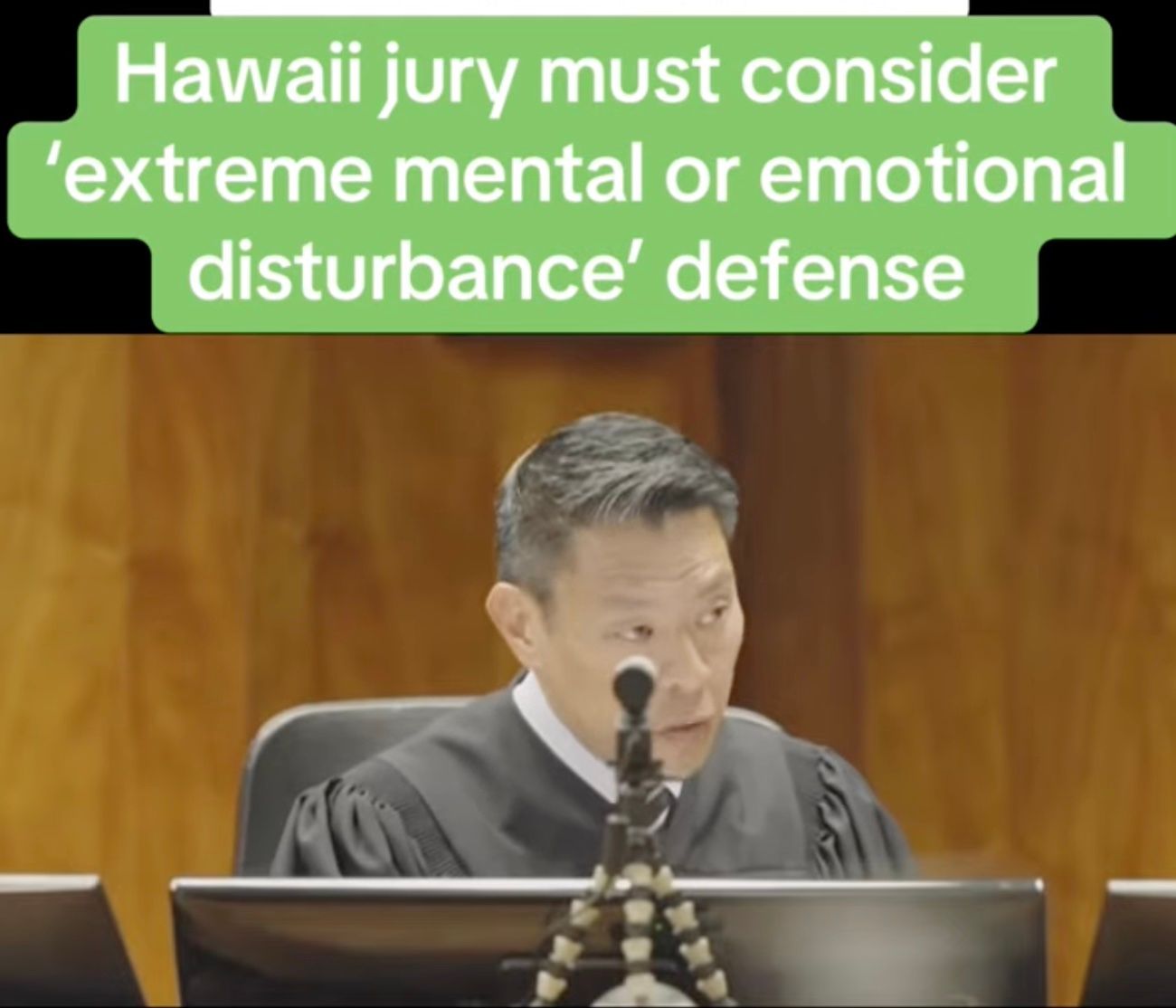
If the defense didn't want it, why was it given to the jury? Under Hawaiʻi case law, the trial judge, The Honorable Paul Wong, was legally bound to include the EMED option. In Hawaiʻi, a court must instruct the jury on a mitigating defense if there is even a "scintilla" of evidence to support it—no matter how small, and even if the defense vehemently objects to it. Judge Wong was legally obligated to provide the instruction to protect the record, ensuring the jury had every possible option supported by the raw evidence.

Mr. Otake never argued for emotional distress and explicitly tried to disqualify it just before deliberations. However, as you legal experts will remember, Judge Wong was legally obligated to include the EMED instruction because Dr. Konig’s testimony unintentionally provided a 'scintilla of evidence' to support a finding of emotional disturbance. Let’s be real folks, the guy cried several times during the trial; emotional distress was inextricably intertwined throughout the proceedings.
Still, when jurors admit on camera that intent to kill was improbable, that is a massive issue. If media interviews from the day of the verdict can be included as material evidence before sentencing, we could see a new trial based on this point alone.
2. The Fallacy of "Attempted Reckless Murder"
The legal definitions of both Attempted Murder in the Second Degree and Attempted Manslaughter require a unanimous finding of an intent to kill. What the jurors described in their interviews was clearly recklessness.
The Legal Reality: You cannot "attempt" to be reckless. Recklessness demonstrates a carelessness regarding an accident, whereas an "attempt" requires acting purposely with intent. You cannot intend to do something you didn't intend to do. Because of this contradiction, the jury essentially landed on "attempted reckless murder"—a charge that is literally impossible and absolutely not recognized by the State of Hawaii.
Want a deeper breakdown of this legal paradox? I actually did a 60-second Short explaining exactly how this works. Check it out on ⬇️

3. The Salacious Live-Stream Leak
Saving the most salacious details for last: during the Law & Crime YouTube live stream of the case, a chat member claimed they were in direct communication with a juror during secret deliberations. This user even correctly predicted the highly unlikely verdict—that Dr. Gerhardt Konig would be found guilty of Attempted Manslaughter due to EMED.
Deputy Prosecutor Joel Garner actually filed a disclosure regarding this, attaching screenshots of the user boasting about the insider communication.
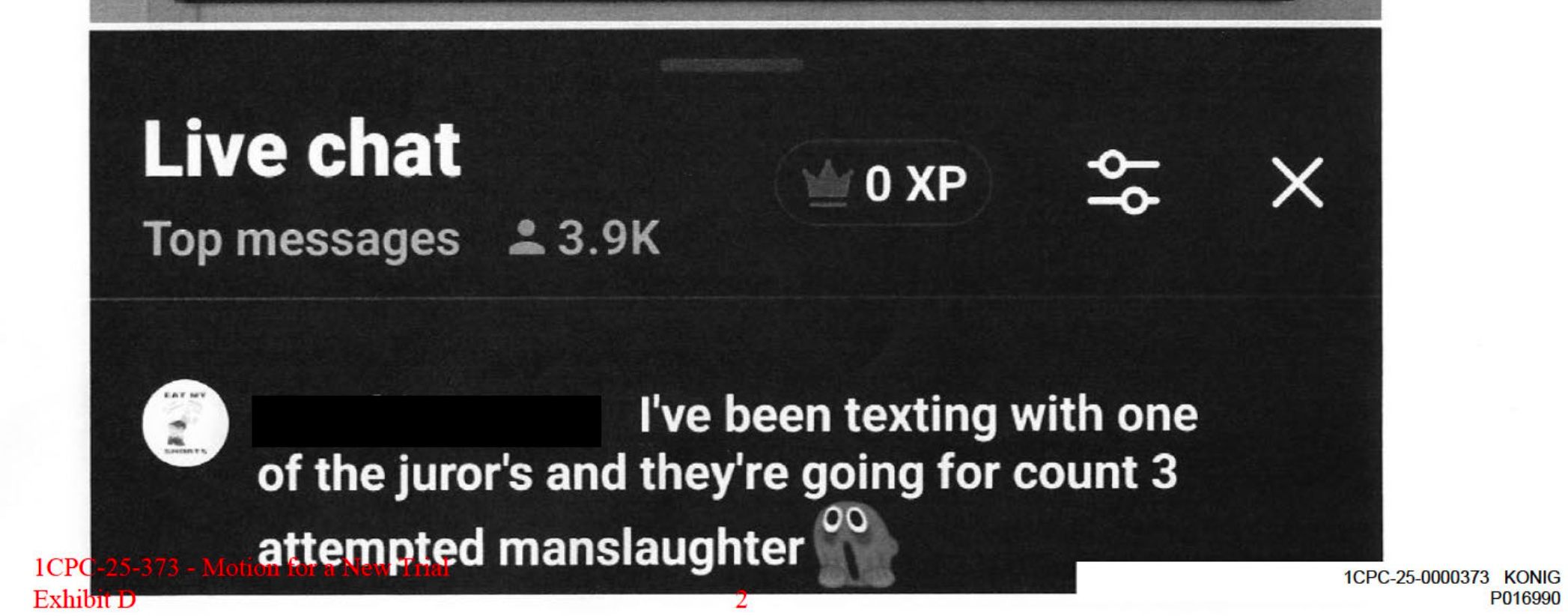
As one former prosecutor and current private attorney told me,
As Mr. Otake writes in his motion, “The United States Supreme Court has recognized that private communications with jurors during trial concerning matters before the jury are presumptively prejudicial, and the burden rests heavily upon the government to establish harmlessness.”
RISK ADJUSTED BRILLIANCE

Pairing these three arguments together feels reminiscent of Mr. Otake’s opening statement, where he leveraged alliteration and the power of three, calling Arielle unfaithful, unwilling, and untrue. This three-pronged attack gives the court three compelling causes to grant a new trial both jointly and severally.

While I can’t predict the future, I know people. I think Judge Wong will look to past precedents where a new trial was mandatory under similar circumstances. I also know that Tommy Otake will not quit this fight; he has been locked in since the get-go, and his sheer power and vigorous objections usually prevail.

Right now, it’s a miracle we are even here, with Dr. Gerhardt Konig looking at a verdict that is actually probationable. However, demanding a new trial is an incredibly high-risk move. It gives the prosecution a "dry rehearsal" to tighten up their arguments and another crack at cross-examining the testimony already given.
The defense asserted in its motion that if a new trial is granted, constitutional principles of Double Jeopardy would strictly bar the State from re-indicting or retrying the defendant for Attempted Murder in the Second Degree. Because the jury returned a verdict of Guilty for the lesser-included/mitigated offense of Attempted Manslaughter due to EMED, that verdict legally constitutes an implied acquittal of the greater Attempted Murder charge.

But now that Mr. Otake knows exactly how deceptive Arielle Konig can be, he’ll have a brand-new game plan to expose the holes in her story. For starters, he can bring in a new forensic expert—one who isn't halfway dead and coughing up a lung on the stand, to be more favorable and drive home the likely truth, that Arielle lied when she said she was hit 10 times with a rock, then covered her tracks by saying, “it felt like approximately 10 strikes,” and add more validity to the theory that she was only hit 2-3 times.

The prosecution may have the advantage of a rehearsal, but the defense now has the blueprint. Will future proceedings upon a new trial be live-streamed on Law & Crime, or will Judge Wong have a change of heart and close the courtroom doors?
These are all legitimate questions, which we will be following closely. Stay tuned folks.
God of War Fanboy..
-Jail Mail Nick